
Keeping the magic alive


Arthur C. Clarke, the legendary science fiction author, formulated three scientific laws over his lifetime. Apparently he stopped at three on the basis that three laws had been good enough for Newton. His first law suggests that when a distinguished but elderly scientist states that something is possible, he is almost certainly right, when he states that something is impossible, he is very probably wrong. While the second maintains that the only way of discovering the limits of the possible is to venture a little way past them into the impossible. But it is his third law that is by far the most interesting and celebrated as it states that any technology that is sufficiently advanced is indistinguishable from magic.
On any technological journey there are moments when what suddenly becomes possible is so extraordinary that an invention or innovation is indeed indistinguishable from magic and is capable of inspiring the same awe and delight. That was surely the case when farm workers first saw Stephenson’s rocket dashing through the English countryside at all of 24 miles an hour. Or the first telephone call people experienced, the first television broadcast they saw or when they were first able to phone people from trains that by now were traveling a little faster. In the early days of Sky+ a customer told me that that the product simply defied the laws of physics and that’s exactly how pausing live television felt, akin to witchcraft.
Of course in time the things that once thrilled and delighted us become part of the fabric of our lives, indispensable but less inspirational. Perhaps this explains the enduring success of Apple, just as a piece of their technology becomes a bit ho-hum and commonplace they perform another piece of magic that raises the collective pulse and the value of their stock simultaneously.
Today smart-phones are on the cusp of moving from magical to indispensable and there are important implications for brands developing applications for these devices. It is the culture of applications that has catapulted mobile devices back into the relm of witchcraft, applications that have fundamentally changed the role mobile techonology plays in our lives from monitoring our sleep cycles and to showing us where our train is on the track so we know whether we have time to catch it. Applications that actually make our lives work better.
Unfortunately not all brands seem to understand this. Too many brand owners still see i-phone apps as brand froth, something that shows that the brand ‘gets it’ rather than a way to help to make people’s experience of that brand better. As a Barclaycard customer nothing winds me up more than the fact that their smart-phone presence is limited to a silly little waterslide game designed to make their advertising more famous when actually I want to interact with my card account through my i-phone, Nat West customers can and so why can’t I?
It is precisely the powerful new roles that smart phones play in our lives that makes this unacceptable, it means we expect brands to have a meaningful presence on our smart-phones and are disappointed and even angry when this isn’t the case. An anger towards brands with non-existant or superficial applications I call ‘appoplexy’.
Of course creating proper apps rather than games takes far more time and investment since these are product and service extensions but as the once impossible becomes commonplace brands that don’t understand Clarke’s three laws are not only missing out on inspiring awe an delight in their customers but run a real risk of failing their most basic expectations of that brand.
Are Superbowl really that super?

Image courtesy of BeckyAV
This is an article I wrote in the week after the Superbowl. So it lacks a little in the topical department. Thought I'd post it anyway.
In the distant past when advertising was a simpler and somewhat more lucrative business the wine bars of Adland would fizz with excitement every third Thursday of November. The cause for celebration was the arrival, straight from the vineyards, of the first pressing of the Gamay grape, a Beaujolais wine by the name of Noveau. And it wasn’t just the toast of the advertising fraternity, for a short time Beaujolais Noveau made it into the mainstream social calendar; the BBC might even follow its journey to fill out the final five minutes of their news bulletins.
That we no longer mark this viticultural celebration is for one reason and one reason alone. The wine is actually rubbish. Only fermented for a matter of weeks it is rather immature and needs to be drunk immediately to stand a hope of delighting the palate. In truth the hype surrounding Beaujolais Noveau was all spin and little substance.
It’s now time to concede the same is true of the Superbowl. Not as a spectacle of sporting endevour but as a showcase for brands and their advertising. Every year the advertising community, and in truth the wider world, gets terribly excited about the festival of advertising that graces the screens of the great American public and every year they have less and less to be excited about. As Gareth Kay, the Director of Digital Strategy at San Francisco agency Goodby Silverstein, tweeted the morning after Superbowl XLIV, “if this is the shop window for American advertising, then its time to get a new shop”.
Perhaps the rot set in years ago but brands, agencies and media owners have been desperate to maintain the pretence that Superbowl advertising is something rather special. With an estimated audience of 90m this event is after all the last bastion against media and audience fragmentation and at $100,000 a second the cost of entry ensured only decent brands with decent creative appetites were able to join in the party. The reality however is all we get is a parade of mainstream brands with lacklustre ideas, few of which come close to the sort of participative work that is charting the future direction of our industry.
Sure there was a half hearted attempt to co-opt the power of Facebook this year, Bud asked its fans on to chose their commercials and Coke offered theirs sneek advertising previews but no amount of tinkering with social media can make up for the appalling quality of the actual ads. Let us never forget that this was once the showcase for the most breathtaking work in the industry’s history, it was the stage for the first airing of the seminal 1984 commercial for Apple.
The irony is the only really interesting ad was from the advertising industry’s nemesis, Google. In a desperately simple execution it celebrates the way search not only delivers information but effectively charts our lives as they unfold and concludes with a new brand line, Search On. Not only is it fascinating to witness the commercial debut for business that has become the most valuable brand on earth by never advertising but this was surely the cheapest ad to make in Superbowl history.
Ironic it may be but think of this not as an admission that to build its business further Google has conceded that it needs the power of commercial television and in particular the Superbowl but as the most obvious overture yet that it wants to be at the heart of the advertising industry and not the architect of its destruction. And I for one will drink to that.
This post originally appeared as a column in New Media Age
More sex please, were British
.jpg)
Image courtesy of Dave Gorman
I have long believed that advertising is not a profession. Don’t get me wrong, I’m not embarrassed about what we do and I certainly have little sympathy with the sentiment of that terrible old joke. You know the in which someone asks that his mother is not told that he works in advertising since she thinks that he is the piano player in a brothel. However, there are a number of reasons why the idea that what we do resembles a profession rings a little hollow.
Firstly you need no specific qualifications to practice advertising, one of the primary criteria for any occupation being seen as a profession. In fact you need no qualifications whatsoever to do what we do and be very good at it. Secondly there are no professional bodies to which you have to belong, that police the profession and from which you can be expelled for malpractice. Sure there are industry associations that agencies and clients are encouraged to join but membership is not compulsory. Thirdly is the small matter of what we get paid for. Where other professional service firms sell certainty we sell only possibility.
Real professions offer certainty because their expertise in a particular area allows them to predict the outcome of their recommendations accurately. That’s true of lawyers, accountants and even management consultants when they stick to the supply side of the value equation.
That simply doesn’t happen in advertising. Expertise and knowledge are valuable but they aren’t really the reason that people use our services or the services of one agency over another. Because that expertise can’t in itself guarantee the effect that creativity will have on customers and the outcome this in turn will have on their business. You can have a feeling for the work and you can research that work but you never really know what is going to happen in the real world. This has never been more true than now because the real media with we work with is no longer television, print, outdoor or even online or search. The real medium we work with is the degree to which people are interested in what our brands are doing and want to engage with it. Try predicting that!
The traditional response to this has been one of denial. To ape the professions in order to add a veneer of certainty and responsibility to what we do. To bang on about accountability, return on investment and wear a lot of very dull grey suits to prove that we are serious.
I want to advocate a return to an industry that believes in sex. Not in our work but in the way that we behave. What advertising people used to understand is that to sell ideas that engage the right hand side of our brains and those of our customers we need to create an atmosphere that is conducive to this – sexy agencies. And in order to land recommendations based on conviction and not certainty we need to build personal relationships with clients based on mutual liking - sexy people. This is the reason that an agency of any discipline gives up its sexy location for somewhere cheaper, stints on the front of house service, or employs talented but dreary people at its peril.
In advertising our recommendations rarely sell themselves, they need help. That is why it is time to dump our pretence at being a profession and recognise that for us all, sex sells. Maybe the idea that we play the piano in a brothel is actually a rather good metaphor after all.
This post appeared originally as a column in New Media Age
The price of everything and value of nothing
Image courtesy of Neato Coolville
As brand builders we have always instinctively felt that the sales lever so beloved by consumers, the price promotion, was not just grubby but also rather damaging to the long term health of that brand and business. That said, we have rarely been able to articulate our dislike of price promotions in a way that stands up to any kind of scrutiny, making us seem petulant and un-commercial in the face of the quick volume that can be delivered by discounting.
However, proof that our instincts might have some veracity has recently emerged from the well-established but newly fashionable discipline of Behavioural Economics. Apparently we actually do know the price of everything and the value of nothing. Instead of the price we pay for something being the consequence of its real value to us, in practice causality runs backwards and so discounting actively demeans the perceived quality and efficacy of a brand.
But it’s not just the world of irrational price perceptions for which Behavioural Economics offers an explanation. As the study of why people rarely act consistently and rationally it is the natural academic bed-fellow of the business we are all in – turning human understanding into commercial value.
It is helping us better understand the biases and rules of thumb that people use to make decisions and therefore how to influence them. And offers an explanation for why people will work harder to avoid losing something than they will to gain it, why they engage less with future events than they do with the present and why they are more likely to complete tasks when they are broken into manageable chunks. Importantly the subject also covers choice architecture. Choice architecture is the reason why people that are given the choice of fish or chicken on a menu often chose the fish but when beef is added they then change their minds and choose the chicken – the addition of beef making chicken seem a relatively healthy choice rather than the least healthy dish on offer. It is the rationale for something that website designers and market researchers have always known, that there is no neutral way to present a choice and that the way it is framed is fundamental to the decisions we make.
Not surprisingly, this challenge to the economic orthodoxy that stalks the boardrooms of our clients’ and their stakeholders, is flavour of the month in adland. Championed by Rory Sutherland, the enigmatic incoming President of the IPA, Behavioral Economics is seen as a means to unite different marketing communications disciplines under one common framework for the way we influence human behaviour. It is also hoped that it is a way to give the industry more than half-baked explanations of the power of creativity to use in those very boardrooms our fates and levels of remuneration are discussed.
Of course it’s easy to see the new-found popularity of Behavioural Economics as another example of the industry’s neophilia. However, the degree of engagement with this subject across our business suggests it may be as significant to advertising as the introduction of Freudian analytical techniques in the 1950s – what we now call qualitative research. And in offering robust justifications for the effectiveness of what we do it also suggests a way to grow the entire brand advice business rather than perpetuating the status quo in which agencies can only grow at the expense of other agencies, disciplines can only grow at the expense of other disciplines and in which the business is constantly under pressure to discount its offering, devaluing the value of our own brands to our clients.
This post originally appeared as a column in New Media Age
e
Shock and awe
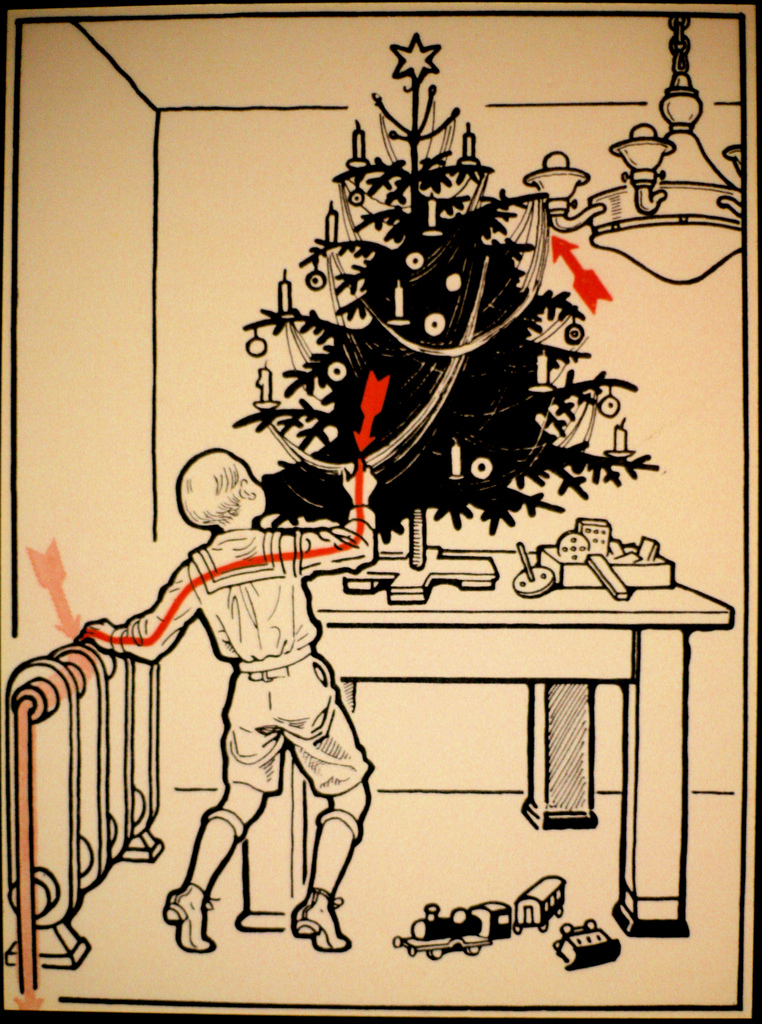
From 30 ways to shock yourself. Image courtesy of Bre Pettis
If there is one enduring fascination the mainstream media has in our business it is with shock advertising and specifically whether shock advertising actually works. Other preoccupations of the journalistic classes come and go – greenwash, teaser campaigns, neuroscience and the like – but the one they keep coming back to is shock.
This is partly because every so often an ad is so controversial that it forces itself onto the news agenda, like the recent film from Germany in which a woman gets jiggy with what we later discover is Hitler in order to suggest that sex with HIV makes you a mass murderer. It’s partly because people outside the business are naturally bemused when advertising actively sets out to create a negative reaction, given the vast majority of our output as an industry is anodyne in the extreme. But it’s mainly because we have never really given them a particularly convincing argument about why we use shock.
Sure there is the standard explanation from the terminally short of thinking that shocking advertising works because it gets talked about. To which we could now add that it probably garners a gazillion empty views on the favoured video sharing site of the moment. And all the better if the thing gets banned as this creates instant notoriety. What we might call the Frankie Goes to Hollywood theory of ad effectiveness appears to me to be entirely bankrupt and dangerously short termist. Incidentally no serious advertising agency ever tries to get an ad banned, which is the equivalent of designing a car you know to be a death trap just to garner some newspaper headlines.
So if it is not about talkability in itself why do we do it? Why does shocking advertising work.
If there is one thing we now know beyond doubt it is that emotional persuasion is rather more effective than rational persuasion, except in some very limited circumstances such as direct response advertising. As the neurologist Donald Calne puts it “the essential difference between emotion and reason is that emotion leads to action while reason leads to conclusion”. If you really want people to have a change of heart rather than simply a change of mind you are far better off generating a deep emotional reaction to the brand.
The Cadbury Gorilla communicates nothing rationally but leaves people with a feeling of joy, the Fatty Fuiags work for the British Heart Foundation is effective because it creates a deep sense of disgust while the evolution spot for Dove generated a real sense of anger at the unrealistic images of women in beauty advertising. Indeed in an era of participation marketing it is clear that emotion is the greatest form of interaction any piece of communication can create, and of course shock is one of the most powerful emotions we are able to generate.
Shock is the way you feel after the ’30 for a reason’ ad that shows a little girl coming back to life having been hit by a car traveling at 30mph rather than 40mph. And shock is the reason you will check your speed the next time you are pushing it in a built up area.
We use shock because it touches people at a fundamental level and spurs them into action not because it gets us a few cheap headlines and the censure of the conservative elements in society. And the same can be said of any work that truly engages people’s deeper emotions. So whether or not your brand can legitimately use shock, that in truth seems to work best for public service campaigns, it should certainly be working on people’s hearts and not just their heads.
This post originally appeared as a column in New Media Age
Who is to blame?

Image courtesy of Planoscorpio
Say what you like about Cannes but at its best it still serves as a barometer for where our industry and our product is heading. Most notably the Titanium shortlist, packed as it is with the coolest work from the coolest agencies and representing the new creative dividend that is on offer to brands that put participation at the heart of their work.
But the obvious question is that if this is the sort of work we all admire from the sort of agencies we all admire how come the UK is so poorly represented? Having offered the industry creative leadership for so many years is our inability to compete with the Droga 5s, Crispins, Goodbys and Nitros of this world proof that the UK is to be a foot note in the future of creative communications?
Ok so the Great Schlep emerged from a unique set of historical circumstances and perhaps its unfair to flagellate ourselves over much for failing to deliver campaigns of this nature day in day out. However, work like Queensland’s ‘Greatest Job on Earth’ and the Whopper ‘Facebook Friend Sacrifice’ came from the kind of briefs that grace our desks on a weekly basis.
So where should we lay the blame for our inability to capitalise on the new creative dividend? Who exactly, in the parlance of our times, doesn’t get it?
Well it sure ain’t the great British consumer that is getting in the way. Educated by Google, trained by Ebay and connected by Facebook our consumers are quite clearly ready to play and in substantial numbers.
And it is genuinely no longer the agency world that is dragging its collective feet. Sure the orthodox advertising agencies may have been a little slow on the uptake but once we got with the programme ur ambitions, attitudes and capability to deliver the campaigns of the future changed radically.
No, without a doubt the people struggling hardest to ‘get it’ are within the client community. It is their silo’s, their pre-testing regimes, their moribund metrics, their accepted wisdoms, their fear of risk, their politics and their obsession with short-form TV advertising that is the most significant break on the greatest future facing work coming out of the UK. Sure there are some inspirational marketers inside our greatest brand owners but invariably they sit at the helm of organisations that struggle desperately to brief and buy campaigns that have even one foot in the twenty first century.
For UK advertising to lead the world again we must now ask our client community whether it is prepared to step out of its collective comfort zone and become once again the patrons of revolutionary marketing.
This post originally appeared in a column in Campaign
Brand respsonse - a case of having your cake and eating it
Image courtesy of Blake E. Marquis.
Eddie Izzard has a standup routine about how useless the Church of England would have been at the Spanish Inquisition, because everyone appearing before it would have been given the option of cake or death. Naturally most people end up choosing the cake option.
The choice is somewhat less clear in the world of marketing. With marketing budgets that used to dwarf our national debt now stripped to the bone by voracious bean counters, marketers face a choice of whether to spend their slim and hard won resources on brand or response.
Every fibre of their being knows that to mortgage people’s long term relationship with the brand on tactical and temporary sales driving activity alone is an act of pure folly. That’s what their training has taught them, that’s what the marketing text books tell them and that’s what their advertising agency takes every opportunity to remind them of.
And yet with real pressure on the business the imperative will naturally be to divert all their funds into lead generating activity both off and online. And with their direct and digital agencies dangling the carrot of bargain basement cost per response online no one is going to be fired for making that decision. This dilemna between response and brand is what in a less elegant past we called jam today or jam tomorrow.
Well it may well be possible to have your cake and eat it complete with lots of jam. Help is at hand in the form of an approach that goes by the imaginatively named title of brand response. Can you see what they did there? Now admittedly at first sight this idea appears to be a monumental fudge that’s almost certain to satisfy neither the objective of building an enduring relationship with consumers nor building immediate sales. And it probably is if you simply take your brand work and slap a harder sales message and call to action onto it and hope for a decent response.
However, real brand response activity approaches the problem strategically not just executionally. If the primary objective of brand advertising is to get people to ‘like the brand’ and the primary objective of direct response advertising is to get people to ‘buy from the brand’ then the objective of brand response advertising should be to get people to ‘like to buy from the brand’. And that means not just dumping value claims and offers into the market in the way direct response does but also delivering a compelling context for that claim. The context that ensures consumers understand the reason the brand is offering that deal. And right now that’s a fundamental reconfiguring of value in the lives of consumers, what we might call a new-value mindset.
Sainsbury’s gets this and right now excels at imaginative brand response marketing. Under the ‘like me’ brand idea of try something new today, initiatives like ‘love your leftovers’ and ‘feed your family for a fiver’ have people queuing up to buy from the brand and loving every moment. Small wonder that Sainsbury’s are taking the predominantly response driven Tesco to the cleaners.
Which leaves us wondering what a new world pf brand response means for digital. Online brand activity seems far more segregated into ‘like the brand’ and ‘buy from the brand’ than offline, into apps and experiences on the one hand and cheap and cheerful direct response advertising on the other. Fine if these are just tools to compliment other marketing activity, but not much of a future as a stand-alone industry. Perhaps its time for the digital marketing community itself to make a choice between cake and death.
This post appeared originally as a column in New Media Age
The summer of the comeback
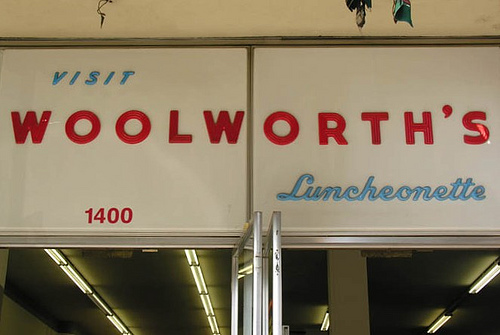
Image courtesy of Dave van Hulsteyn
This is the summer of the comeback. Blur are back, Oasis are back, Abba have been approached to take part in a tribute to Wako Jacko and Glastonbury almost saw Crosby, Stills, Nash and Young harmonise with each other once more. And just six months after Woolworths finally threw in the towel and swore never to play live again it too is back, although the performance is entirely online now.
Having bought the brand name from the receivers, Shop Direct has relaunched Woolworths online and declared, through a variety of newer and older media that it is ‘now playing’.
Now I have to admit to being more than a little bit cynical when they first announced they had bought the brand and were going to bring it back. For me Woolworths seemed a retailer that had lost the plot, lost any idea of the role it played in people’s lives and so justly lost the will to live. And its comeback seemed the worst kind of nostalgia marketing, more tribute band than legendary reunion. However, I’m not so sure now, the new Woolworths seems really rather good.
More than that, the launch comes at the perfect time, offering people sunny optimism and the comfort of a well loved brand at a time when people are feeling more than a little pessimistic. They have not only brought Ladybird children’s clothes back, they even sell pick’n’mix on the site, arguably Woolworths signature product.
And in creating an e-commerce only offering Woolworths 2.0 has resolved many of the problems that dogged the 99 year old high street retailer. Not least the effect that selling anything with a bar code on had on peoples understanding of the role of Woolies. This brand is now fairly and squarely about ‘play’ something that was always at the heart of Woolworths but that was monumentally obscured by the industrial-scale fly tipping that characterised their highstreet inventory.
Indeed there must be retail chiefs up and down the land that are green with envy that Woolworths has been able to dump their undifferentiated highstreet and out of town stores in favour of an infinitely smaller but more focused and potentially far more profitable online offering. Retail chiefs that know that they don’t have a hope in hell’s chance of following suit unless they crash the business and call in the receivers. Yet another example of how the City mitigates against bold decision-making in British businesses.
So a brand on the cusp of its centenary has been rescued form the dump bin of retail and given a new lease of life. And yet for all of this one can’t help feeling that the real wonder of Woolies has gone and gone forever. The thing that really delighted people, and especially families, about Woolworth’s extensive retail footprint and eclectic inventory was the one thing that online retailing will never be able to deliver, precisely because it has to deliver. The real spirit of Woolworths was instant gratification. Woolies really came into its own when you absolutely had to have it now not in four days time and only then if you wait in for your order to arrive on your doorstep. The real hole left by Woolworths is really the way it acted as an antidote to the need for premediatated parenting.
And spontenity is of course what e-commerce does so badly, unless the product you want can be delivered down the wire. The internet is unsurpassed at arming consumers with information, price comparisons and recommendations, but it remains prehistoric when it comes to actually getting your hands on the stuff, something that remains the enduring USP of the highstreet.
Nostalgia Blackmail
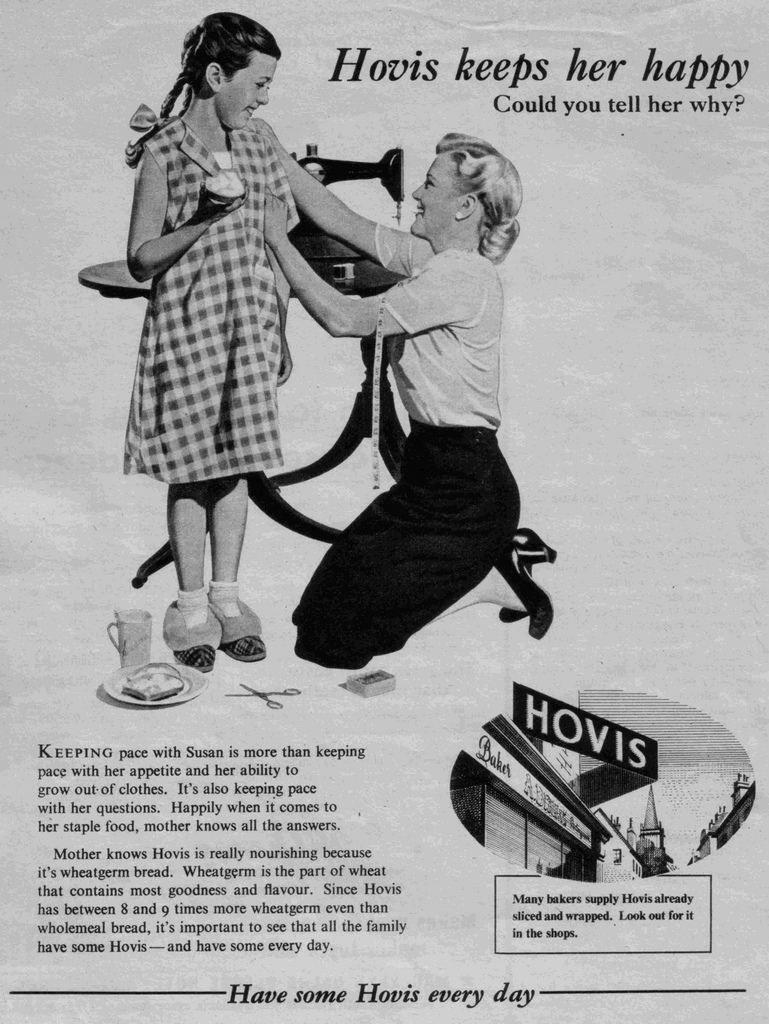
Image courtesy of Old School Paul
One of the defining features of this recession is the number of brands immersing themselves in utterly self-indulgent nostalgia trips in a desperate attempt to curry favour with increasingly cynical consumers.
Hovis were first out of the traps last year with their British history lesson on speed that picked up where the flat cap wearing delivery boy and his bike left off in the early 1970s. Although by then Mars had already heralded the dawn in a new age of nostalgia by returning to their iconic ‘work, rest and play’ endline.
But recently the trickle of nostagia has assumed flood-like proportions. And there is clearly no better way to dish up a bit of ‘as good today as it’s always been’ than by celebrating a brand’s birthday, particularly if the number you can come up with is north of a century. All of which explains why flamboyant tours of brand heritage are flavour of the month in ad-land.
In a brief cease-fire in the hotly contested dine-in-for-a-fiver battle, M&S and Sainsbury’s are currently slugging it out to prove exactly how incredibly old they are. Although whether producing almost identical ads, right down to both supermarkets claiming to have introduced the avocado to British palates, was a wise idea is debatable. Especially as they both try to out Hovis Hovis in the sepia tinted film and street urchin department.
While over in the detergent category Persil is busy telling us they have reached the relatively modest age of 100 by re-running the ‘best’ of their historical ads. I put best in inverted commas because if this were a brand like Guinness a retrospective of their work would be a thing of pure and absolute joy. Not so Persil which has largely forgotten to make any memorable work while it has been doing such a good job washing our whites whiter.
Planners will tell you that these brands are rather cleverly exploiting the hoary old insight that in difficult times like war, natural disaster or in this case a slight downturn in the property market, consumers yearn for the comfort and certainty of the past and of brands that have been knocking around a bit. Hence the impetus to roll together a brand’s birthday with a sentimental trip down memory lane in advertising confections that can only be described at nostalgia blackmail.
Clearly a sense of a brand’s authenticity is important, especially when consumers can now spot a mile off a brand that has been conjured out of thin air in a NPD brainstorm. However, I struggle with the idea that recalling a time when our child mortality rate dwarfed that of modern day Sierra Leone and contracting Tuberculosis was our national sport holds much value for brands seeking relevance to people’s lives today.
Indeed brand heritage is totally over rated and really rather dangerous. Take a brand like Hoover that basked in its history as the original vacuum cleaner for decades until a better product in the form of the Dyson came along and ate its lunch. Or for that matter the fact that according to WPP the world’s most valuable brand, Google, has absolutely no heritage whatsoever being only 11 years old. Indeed the most powerful online brands, the ones that we are really taking to our hearts and that have assumed an almost effortless a role in our lives owe their success to the way they allow us to do things that we have never been able to do before and not because the are as good today as they have always been.
Reasons to be cheeerful 1 2 3

Image courtesy of Max Ferguson
Gripped as we are by the bloody teeth of recession and now with conclusive proof from ICM that Britain, of all leading nations is the most miserable and pessimistic about its economic future, it is perhaps peculiar that the most potent buzz word in advertising is optimism. We see it in our consumer’s actions if not attitudes, we see in in contemporary culture and increasingly we see it in the work from the T-mobile Dance event to Coke’s Happiness campaign.
Indeed some recent research we have undertaken at Saatchi & Saatchi suggests that the dominant themes in British culture at the moment are Love, Pride, Optimism and Generosity. How’s that for counter intuitive?
Now it is entirely possible that our new-found predilection for optimistic thoughts and deeds is a short term response to the doom and gloom around us. What was called the Blitz spirit but is best summed up these days in the mugs, T-towels and doormats so beloved of the Boden wearing classes that bear the phrase ‘keep calm and carry on’. Deep down we Brits obviously believe that it was our resolve, stiff upper lips, even stiffer tea and the ability to laugh in the very face of adversity that won the Second World War and not the Americans arriving on the scene. And clearly we believe that this sort of attitude that is just the ticket to face down our current economic difficulties. How else can you explain the wall of coloured denim that greets you as you walk down any high street?
This is all entirely possible. It is also possible that we are witnessing a longer term shift in the national psyche, that we are actually becoming a nation that is less cynical, less pessimistic and less selfish. Of course the proof of this pudding will be in our developing attitudes towards the Games of the XXXth Olympiad in 2012 which may yet be the first national project since the Festival of Britain to be greeted with a spirit of optimism and pride rather than a wall of defeatism and abject cynicism. And it is also possible, if you might indulge me for a moment, that this fundamental shift has had something to do with the internet.
For the healthier part of a decade we Brits have been doing something entirely unprecedented in our Island story, we have actually been sharing things with each other and most of the time with complete strangers. But in one specific location, online, where we have handed over our family photos, our movies, our comings and goings and our innermost thoughts to pretty much anyone who is interested. And that surely is the very definition of optimism, doing something in the belief that good rather than harm will come to you as a result of your actions.
I want to suggest that the current spirit of optimism has more than a little bit to do with a Nation that rather likes the generosity and culture of sharing that is shown to them and they in turn show to others in their online lives and now want to practice this in their offline lives. That a population now comfortable with the likes of flickr, twitter, facebook and youtube are now ready to take the next step and start to talk to people on public transport. And if that happened maybe we could finally conceed that the internet is not another channel as so many people in the advertising industry once hoped it would be, but a way of living that is now influencing the larger part of our lives.
Context is king

Out of context is viewing online commercially valuable? Image courtesy of papa'rocket.
As we career head long into the economic car crash that is destroying jobs, crushing consumer expenditure and ripping the confidence and profitability out of both client and agency organisations, one performance metric has emerged above all others to guide us through these tricky times.
It’s not a measure of efficiency like cost per response, it’s not a measure of likelihood to purchase like brand consideration and its certainly nowhere close to a measure of return on investment. It is the number of people viewing a commercial online.
Right now the advertising industry has become obsessed with this one measure of performance above all others, we even have our own chart at viralvideo.com to add a little competitive frisson between agencies.
Now, it is easy to see why ad people love online views, it is a pure measure of creative prowess. Of course a brilliant seeding strategy can turbo charge online distribution but by and large, unlike traditional media, you can’t buy the audience. Your content has either got what it takes or it hasn’t and that places real value on the thing that agencies value the most and get paid to deliver – creativity.
Of course we have to be realistic about the reach that online viewing can contribute. You have to have something pretty spectacular on your hands like the T-Mobile Dance ad or Cadbury Eyebrows spot to generate the big numbers that make online a serious contender as a distrbution medium. However, the counter argument is the value of an audience that elects to view a commercial message rather than one that is served it regardless of whether they are remotely interested or paying any attention whatsoever.
As a legendary house ad from the ad agency HHCL read while showing a couple going at it hammer and tongs on the sofa oblivious to the TV playing in the foreground, ‘research says these people are watching your ad, who is really getting screwed?’ It seems self evidently true that one voluntary and attentive viewing of a commercial is worth considerably more to the advertiser than the many potential views that a commercial break may or may not have delivered.
Now, not that I want to rain on the online viewing parade but I do want to encourage a moment of caution before we all drink the YouTube Koolaid. Caution inspired by the idea that it’s not only content that is king, context has a pretty good claim to the throne too.
When people watch an ad on the television it is delivered to them in a commercial break. A break in the content that is overtly signposted as an opportunity for people to sell their goods and services and understood as such. The audience has been conditioned to decode the content they then see as ads and that their job is to figure out what is for sale and who is selling it. No matter how eyewateringly creative or side splittingly enjoyable the work, this is clearly understood as a commercial transaction between advertiser and audience. And though it’s hard to quantify exactly, it is clear that this context adds considerably to the success of the content.
And that’s what concerns me about the hoopla around online viewing. Is an ad an ad when it’s viewed out of the context of an ad break? Or does it simply become a piece of sponsored content, engaging and enjoyable but neutered of its commercial power and therefore of dubious valuable to the Client’s business and a rather inappropriate a metric to be fixated on at this particularly mercenary time in the economic cycle.
Hat tip to Paul Colman who got me onto this and is undertaking some proper research on the subject as we speak.
r-e-s-p-e-c-t

Image courtesy of badjonni
I have a very cruel, but accurate, joke about why planners have adopted social media with more enthusiasm than others in the advertising business. In advertising only planners blog, account handlers have nothing to say and creatives have better places to say it.
Indeed planners have taken to the world of online self-publishing with an alacrity they once reserved for pouring over extremely dull quantitative research. The same goes for virtually every other online or mobile tool that enables people to share their lives, photos, films and even powerpoint presentations. The online planning community is so vibrant that it even has its own name, the plannersphere.
This enthusiasm is very specific to the nature and role of planners. These are naturally the most geeky people in an agency, obsessed with why people do things and how to get them to do something else, so they have always naturally gravitated towards shiny new things.
They also crave community, since outside the major English speaking advertising cities planners are often on their own or in very small and isolated departments. The opportunity to join a network of people doing the same job and experiencing the same challenges has been a godsend to the planning diaspora.
There is also the distinct possibility that in many agencies planners lack a voice and and audience for their ideas and thinking and so have latched onto social networks as a way to ensure their ideas and opinions are met by welcoming ears.
Which simply leaves one critical question unanswered. How come there are precious few examples of brands using social media well? How come the great social media case studies of the moment start and end with Wispa and its army of Facebook fans. After all aren’t planners, as the architects of brand ideas and communications strategies, in a perfect position to influence brand behaviour online. Why haven’t planners translated their personal enthusiasm for blogging, tweeting, poking, uploading and sharing into the activities of their brands?
I maintain that it is precisely our familiarity with these tools that has placed a brake on their widespread adoptions in communication planning. It has always been the case in advertising that the more a medium means to the people in the business the more care we take over it. This partly explains why more love and attention has traditionally gone into TV advertising than into Direct Mail and Telemarketing.
So it is with social media, planners get what is going on and understand the nuanced etiquette that is expected of anyone wishing to participate in these communities. We understand the two key rules you must abide by if you are to take part in online social networks. That brands, like any of us, have to let go of the control they crave if they are ever to gain influence. And that social networks are built on simple human conversations, and a brand only has a role if it can make that conversation better. Above all we understand that the most rewarding presence that any brand can have is through the natural enthusiasm of its fans much like the devotees of Mad Men have done in twittering as members of the cast.
So forgive us for being slow in delivering plans that involve the mass adoption of the social networks that we love, it is precisely because we use and care about them that we are extremely cautious about the involvement of brands in this space. Meanwhile we will continue to use social networks in the way that best benefits our clients at the moment, as a means to listen to the conversation.
Calling time on digital's cult of accountability

Image courtesy of Aussiegall
Occasionally I have the enormous pleasure of judging New Media Age’s Interactive Marketing and Advertising Awards. And a very splendid awards scheme it is too, with this year’s kings of the digital castle crowned in some style last month. I get invited to fill the ‘enthusiasm-over-experience’ role of digital-curious advertising outsider. This usually involves gobbing off in a cavalier fashion and then being slapped down by people that actually know what they are talking about.
However, there is one territory on which I feel on more solid ground, and that is campaign accountability. And in particular the ludicrous way in which the digital community generally sets about proving effectiveness, a not inconsiderable criteria, both in judging these awards and in the current business landscape.
Let’s be direct about this. Judging by many of the less successful entries, the standard measure for return on investment would appear to be the difference between the cost of the campaign and the cost of reaching the same number of people in more conventional media. That is not a return on investment, that is the sort of haphazard disregard for accurate accounting that precipitated the current global financial crisis.
Indeed, any effectiveness metric that does not tell you the incremental profit that your marketing activity generated for the business isn’t worth the paper it is written on. Not click through, not cost per impression, not cost per response, not page views, not dwell time, not fanciful measures of engagement. Incremental profit. And if that seems an extraordinarily difficult thing for most digital campaigns to demonstrate, I’m heartily sorry. But it doesn’t make it any less imperative the industry resolves this question, because it isn’t going away.
And I lay the blame fairly and squarely on digital’s cult of accountability. Accountability sounds like a thoroughly noble endeavour because it suggests an appropriate use of the client’s budget and an ability to show what happened to it. It is also a really handy stick with which to beat advertising agencies and their big production budgets and legendary levels of media wastage. However, accountability is a bottom up measure of success, and in truth it measures efficiency not effect. If digital agencies show client how wisely they spent the budget against the competition and versus last year, advertising agencies look at what happened to the business and then try and show how their activity contributed to that success. In other words they approach effectiveness from the top down, a fundamentally different world-view.
In fact it is precisely this cult of accountability that is getting in the way of the digital community progressing from clever marketing handymen to the architects of brand success. After all what Chief Executive is really the least bit interested in how responsibly any one has used their money? What they tend to be concerned with is whether their marketing is having an un-ambiguously positive effect on the growth and profitability of the business. In response to Lord Leverhulme, who cares if half your marketing budget is wasted if the other half is shifting shed loads of product?
So long as the digital community clings to its obsession with accountability over effectiveness it will remain in the unedifying position of creating engaging brand fluff on the one hand and highly measurable but largely pointless direct response advertising on the other. If that sounds like a future to you then fine but I’d suggest changing the fortunes of a client’s business is a finer ambition to hold. And that is going to need proper measurement.
Great ideas can come from anywhere, my arse
 Image courtesy of Markus Nielsen
There are many terrible cliches that lurk like sewer rats in the daily effluent of the advertising industry. And much like sewer rats they are always close to the surface, wholly unpleasant and bloody difficult to eradicate.
By far the most pernicious and destructive is the now widely held belief that ‘ideas can come from anywhere’. What this annoying little platitude means is that anyone engaged in a project whether client or agency and regardless of their discipline may be the person that cracks the big idea.
So far so good and of course like all cliches it did have a use at one time. By the 1990’s above the line advertising agencies had become so overwhelmingly and unjustifiably arrogant that they effectively acted as a block on any form of collaboration or innovation. Whether within those agencies, between agency and client or between the different disciplines that were beginning to partner the advertising agency to deliver integrated campaigns.
Against this approach there was real mileage for those in the market that refused to indulge prima dona behaviour, that had more fluid and collaborative working practices and who were far more open to partnering other agencies. As a sales trick, suggesting that an idea can come from anywhere worked a treat, and indeed some clients more interested in the process of making work than the quality of the end result, lapped it up.
The trouble is that while there may be some truth in this belief - theoretically great ideas can come from anywhere, just as theoretically a sufficient number of monkeys equipped with typewriters will create works of great literary merit - it is a disaster for clients and agencies alike.
Maybe the odd idea can come from anywhere but from whom are breathtaking strategic, creative and executional ideas more likely to come? Who is more likely to be the architect of a ground breaking piece of strategic thinking? Who is more likely to find a creative expression that dramatises it in a way that has never been experienced before. And who is more likely to create an executional approach that mesmerises people? It could be anyone involved in the project but my money is on those people that do this every hour of everyday of their professional lives, people that instinctively know when something is verging on greatness or just a pile of tat.
And what on earth is the future for any company in the ideas business that pays its people and its rent by creating ideas no one else can possibly come close to, if they believe that actually its a piece of piss and anyone can do it. After all you don’t find architects running around suggesting that anyone can design a building or even that any other architect can design a building as well as they can. An agency might as well pack up shop and go home if it doesn’t have enough self respect to think that, although anyone might come up with an idea, no one is likely to come close to the God like genius that they can rustle up.
Clients value great ideas, they pay us for great ideas and they stay with agencies that consistently author great ideas. Any agency worth its salt will ensure that, while there may be a scintilla of truth in this hoary old cliche, the greatest ideas only come from them.
Telephone research must stop. Full stop.

Image courtesy of Old Telephones
Let's agree this now everyone. There are some things marketing and communications should steer well clear of and the telephone is one of them. So lets have no more telemarketing spam, lets have no more political parties ringing people up with an automated message and lets have no more telephone research.
Planners in advertising have a dark secret. While we spend a considerable amount of time commissioning and using quantitative research, we very rarely take part in it. Indeed, like most people that work in marketing, we are screened out from almost all market research. This rather arcane practice is based on the quaint idea that respondents should be ignorant of the research process thereby ensuring more accurate answers. This is similar to the way animals entering an abattoir are made unaware of their surroundings and so succumb to the experience placidly and without distress. Nice placid respondents are exactly what researchers like.
However, there is something deeply troubling when people asks others to undertake anything that they themselves never experience as customers. And so it is with research, where the end users of quantitative surveys often have no real idea of what it feels like to be a respondent, whether its because they decline to take part or are screened out from the interview in the opening seconds. The truth is that if we all had to go through the full horror of a thirty minute questionnaire, we would never let the length of our surveys get out of hand. If we ever had to experience the frustration of being asked to chose from a selection of banal pre-scripted answers that don’t reflect the way we actually feel, we would ask more open ended questions. And if we ever had to endure the imposition, irritation and imbecility of a telephone interview, we would never use telephone research again.
Telephone research, much like its evil twin, telemarketing is a perversion of both the noble role of the telephone and the honourable tradition of research. Not only must one question whether we should submit any fellow human being to the experience, but we should also be extremely dubious about the truthfulness of the results. Not least because finishing the damn thing, rather than recording accurate responses, often becomes the primary aim of interviewer and respondent alike. Thankfully, when it comes to research the telephone is an intermediate technology and one we no longer have to put up with.
While expensive face to face research remains the gold standard the internet is changing the way we acquire the information we all need to do our jobs, especially where budgets and timings are tight. Indeed there are often circumstances where the lack of moderator in online research improves its accuracy over face to face, particularly when it comes to political polling where people are often more honest if they are telling a machine. Online, respondents can chose the time they want to undertake the questionnaire they are participating in, they can consider the questions properly and they can consider the options for their answer properly. They can even come back to tricky questions or take a break from the survey altogether, ensuring that research is completed in a relaxed state of mind and without an impatient low wage interviewer breathing down their handset. While this may reduce the innocence of respondents it is actually possible that people will enjoy online research.
The internet continues to have a profound effect on the marketing business. However, at the same time as the noisy revolution that is taking place in the world of marketing communications the online survey is heralding a more profound but rather quieter revolution in the world of market research. We just need to make sure we take part in it from time to time so that it remains a positive experience for our customers, even if that means fibbing about our profession.
Problems wanted
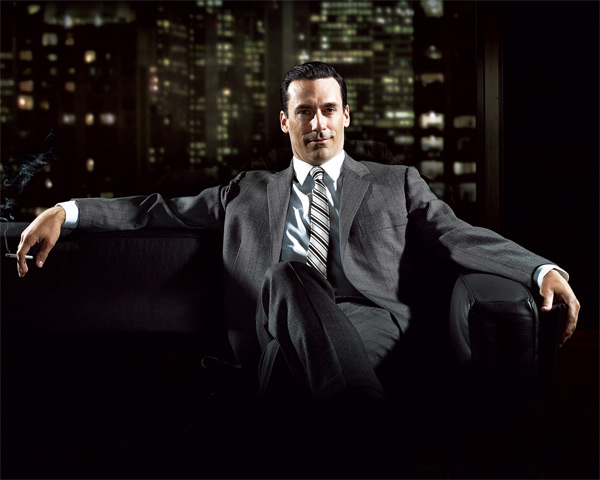
Mad Men, a simpler time of real men, real problems and lots of sex on mid century design classics. Image courtesy of Slate.
Unfortunately much advertising is self indulgent nonsense that simply serves to waste the client’s money and the consumer’s time.
Sometimes, just sometimes this work is the product of precious and pretentious creative endevour that is brought into being simply to puff up the bloated ego of a creative director seeking to shove his make-weight agency up the award’s league tables.
However, more often than not the hollow stuff that troubles us most is not the product of some creative flight of fancy but the result of a hollow brief. And the blame for that must lie squarely at the feet of the client community, for being less than clear about the business problem they are trying to solve and less than clear about how advertising might be used to solve it.
You see advertising loves problems, the bigger and hairier the better. It is one of the reasons that some of the most creative and effective work in the market is done to Government briefs where there is often a proper problem and a need for a serious change in behaviour.
Ask any good creative agency what they crave most from clients and they will tell you that they want a clear and unambiguous problem to solve. In other words an objective. Inspirational client briefs are fantastic, especially if you can get a whiff of the spiritual brief that the client organisation really needs to deliver against. However, I’d sacrifice any amount of inspiration for a serious business objective every day of the week. Serious objectives like ‘slowing the loss of a retailer’s business to online competitors’, ‘increasing every transaction by £1.14’ or ‘become the clear number three in the market by taking share from the two dominant brands’. Not wooly nonsense like ‘increase brand awareness’ or ‘launch our product into the market’ and still less ‘make people love and engage with my brand’.
A desire for proper business problems partly explains the delight taken by the industry in the 1960’s advertising drama, Madmen. Sure there was a good dose of envy over a job which seemed to involve drinking vast quantities of whisky at all times of the day and having sex on top of mid-century design classics. However, its real success in adland was down to a wistful longing for a time when clients were actually clients. In other words the people that ran and had often founded the business being advertised and simply wanted to sell more of their products by any means necessary.
Of course the arrival of professional marketing departments has changed the relationships that agencies have with client organisations and the roles that they play for them. But it hasn’t change the need for clear business objectives.
And don’t for a moment think that the digital world is exempt from this criticism, because of an obsession with accountability. Interaction levels, click through rates and dwell times are important but they are not business objectives. The truth is if ad agencies have got it bad when it comes to getting proper problems to solve the digital community has got it far worse. All too often digital briefs are either at the terminally intermediate end of the spectrum, asking for an ever lower cost per response, or at the terminally fluffy end asking for lots of lovely brand engagement and little else.
This post originally appeared as a column in New Media Age.
Are our start ups a let down?
Image courtesy of Fiat Luxe
The start up plays an almost mythical role in the world of advertising. Start ups are not simply an outlet for the professional and material ambitions of the best in the business, they are absolutely essential to the health and vitality of the industry. If advertising has managed to adapt to the changing business, consumer and communications landscape over the past century it has been largely because of its start-ups.
The concentration of talent and ambition in new agencies, coupled with their lack of moribund processes and crippling overheads means that they are able to
anticipate and quite often precipitate the changes that drive the business forward. Changes both to the process of creating advertising and the product itself, whether the media used or the selling techniques employed.
After all it was start up agencies like Collett Dickenson Pearce that in the 1960s first got their heads around how to use the fledgling medium of commercial television. While successive start ups from Saatchi & Saatchi in the 1970’s to Bartle Bogle Hegarty in the 1980’s and Mother in the 1990’s all used their success to lead the advertising business in new directions. And in doing so frustrated those that repeatedly predicted advertising’s demise.
Of course, while the attractiveness of younger, more agile agencies takes its toll on more established shops and every generation sees many of these fall by the wayside, unable to compete with the new offerings, many others survive and prosper. And they do so precisely because their deep pockets and generous owners buy back the talent, energy and new practices that the start ups have pioneered. And so the young turks return to the fold and in doing so change the agencies they originally left with far greater success than if they had stayed on.
Recently, however, something has gone wrong. In the last decade there has been no let up in the number of new advertising agencies, yet those born in this period have conspicuously failed to maintain the pace of change upon which the survival of the business is so dependent. This has been cataclysmic in London which, starved of start ups with new ideas, has become a shadow of its former, world conquering, self. If you had said to your average adman in the 1990s that the agencies that we would most respect a decade later, would be almost exclusively American they would have laughed into their cinnamon lattes. Not since the 1950s has London adland doffed its cap to the US with such awe struck admiration.
For far too long the hallmarks of the start up - fearless audacity, challenging thinking and world beating creativity - have been rare qualities in the UK’s young agencies. And this has to change if London is to restore its fortunes as a centre of advertising excellence.
Maybe the latest crop of start ups will be different. 2008 has begun with a flurry of agency births, the most notable being Adam + Eve and AnalogFolk, both breakaways from large network agencies. Refreshingly they do seem to promise new thinking and new ways of working, and interestingly both have been quick to bring in talent from outside orthodox advertising agencies, all of which bodes well.
We have to hope that this year’s start ups can deliver real change where their immediate predecessors have not. Because if you want to point your finger at anyone for the advertising industry’s failure to adapt don’t do so at the established agencies - this was never their role - point it at the last decade’s start ups that have delivered so much cash to their founders but so little progress to the business.
This post originally appeared as a column in New Media Age.
Fast Strategy

Image courtesy of Combined Media.
This is a little piece I did to publicise the The days of the stereotypical strategist are over. The business world has little time for the desperately bright, painfully academic, socially inept and ponderous planner. Because, as speed to market and speed of response become powerful competitive advantages, the business world has little time for strategy that gets in the way or slows things down. The perfect strategy delivered to market shortly after the competition has taken you to the cleaners is of no use to man or beast. Indeed, in our time squeezed environment it is tough to make the case for strategy at all. In many agencies we are witnessing the emergence of a ‘ready, fire, aim’ culture. Account people are drawn to this trigger happiness because of their preference for heat over light while creative directors love it because they can give their talent the maximum amount of time possible to bark up any number of wrong trees. And us strategists? Well we simply throw up our arms in despair. And the problem lies in part with the exalted position we have given strategy within our industry. We regard planners and strategists as tortured geniuses as they wrestle with the thorny issue of differentiating parity products in the yellow fats market and we wait for the white smoke to issue from the Vatican chimney to show that their work is done. Great strategy is utterly desirable but in the heat of the battle, utterly dispensable. The truth is that strategy is needed now more than ever – to simplify, guide and inspire. But if we are to combat the obsession with firing before taking aim we have to deliver great thinking faster, rather than asking people to wait while we deliberate. Of course there is nothing clever about strategy, it is simply about having a plan. And a good plan need not take an age to develop, it simply requires a bit of inspiration and to safe guard a little time in the process. And that’s the idea behind Fast Strategy. Fast strategy is about delivering powerful thinking quickly, whether in days, hours or minutes, so that strategy remains in the picture and we can at least aim our activity before squeezing the trigger. Every great strategist has tricks of the trade that help them to deliver great thinking fast and this year’s IPA Strategy Group conference will throw the spotlight on some of these approaches. Not only will showcase the strategic shortcuts of 50 leading practitioners but we will also witness fast strategy in the flesh as three communications legends compete in real time to crack a live client problem. Some will say that Fast Strategy dumbs down the contribution of strategists to the discipline of solving business problems. I suspect they will tend to be those desperately bright, painfully academic, social inept and ponderous planners whose time has passed. Image courtesy of I owe my career in advertising to an ad.
Not to an ad that inspired me but one that I responded to. It was placed by a long gone and deservedly forgotten direct marketing agency trying to find graduate recruits many months after the above the line shops had employed all the good ones. The ad read ‘By the year 2000 90% of marketing will be direct marketing’ and I was sold.
This was late 1989, storm clouds were gathering over the economy and the chronically unsustainable boom of the eighties. A recession was in the offing and most sectors were soiling their underwear, not least advertising that had enjoyed a decade of success and excess. All that hedonism was beginning to cause a headache and the ad business feared the worst. Not so my new found home of direct marketing. All across the land of lick and stick direct marketers were in buoyant mood and trying hard to hide their glee at the impending economic crisis. They were convinced that tougher times would favour a discipline that worshiped at the altar of accountability. Surely, they felt, a recession would deliver the coup de grace for the dinosaurs of advertising and their habit of spending vast sums of Client money on work that no-one seemed to feel obliged to correlate with business success. The philosophy of direct would be vindicated once and for all and, come the good times, healthier budgets would fall at the feet of the masters of Mailsort. Well the shit did hit the fan and many advertising agencies had to send back the Porsches and send out the P45s as Clients cut their budgets and agency fees. However, in the recession of the early 1990’s more direct agencies went out of business and proportionally more direct people lost their jobs than in adland. By the year 2000 even the most generous calculations attribute no more than a third of marketing expenditure to the different facets of direct. And in the aftermath the arrogance of direct all but disappeared as its practitioners got down to building the new discipline of relationship marketing, quietly and without the hubris of the past. The failure of direct in its plan for global marketing domination wasn’t because Clients walked away from cost per response, far from it. Businesses have always valued the ability of direct and now digital to show them what they get for their money, pound by pound. However, in my experience they also believe that there is more to life than return on investment. In leaner years advertising triumphs because it offers a little optimism, to the customer of course but also to organisations that are feeling the pinch. It is precisely at times like these that the power of a big emotional idea, expressed in the most potent way can help galvanise a brand, its people and its customers, delivering pride, purpose and preference for the companies that do it well. Visionary businesspeople have always understood this and usually come out of a recession in far better shape than the penny pinchers. So digital friends, when you think about the current economic climate be careful what you wish for. Of course the Internet Advertising Bureau is crowing about the “perfomance and measurability” of digital and is enthusiastic that tougher times may allow digital to “gain over other formats”. However, I can’t help thinking of the way the direct marketing industry greeted the news of recession a shade under twenty years ago. An economic downturn will be bad news for the advertising agencies but can you really assume it means good news for you? This post originally appeared in the 28th February edition of New Media Age This is my first NMA column for the year and its about measuring the effectiveness of digital campaigns. Obviously there is quite a tongue in cheek theme about bringing the digital geeks and the research geeks together but the serious points are about looking beyond intermediate metrics, the folly of accountability and need for greater ambition in digital campaigns.
As ever, enjoy.
It goes without saying that two of the words digital people seem to loathe the most are ‘advertising’ and ‘research’. Advertising because digital-kind believes itself to be above such a grubby and discredited approach to selling things. And research because this hardly suits the buccaneering spirit of the digital frontier where gut feel and instinct get results. So it was no great surprise that at a recent conference on advertising research run by the eminent people at the World Advertising Research Centre there wasn’t a single soul from the digital fraternity on the delegate list. Now, the truth is that attending a conference like that wouldn’t have even begun to flicker across the minds of most people in the London digerati. I mean, who in their right mind would swap a slap up lunch at Shoreditch House for listening to a bunch of boring research people droning on about how you evaluate engagement online? However, this sort of disinterest is symptomatic of the chasm that exists between the digital world and the research community. Which is a shame because you could be so good for each other. Sure, many research people carry the pallid complexion of those that spend too long sitting ruminating in dank basements, emerging blinking into the light merely to collect data or submit a paper for peer review. Sure, they tend to wear suits that were mildly fashionable in the years preceding decimalisation. And sure, they have a curious way with Powerpoint that involves cramming so many words onto a slide than you’d have difficulty reading them with the Hubble Telescope. But they might, just might, have the answers that you are looking for, or at the very least a way to help you to find them. And of course number one on the list of questions that need answering is how to prove the effectiveness of digital campaigns and specifically the value of engagement. Not with terminally intermediate metrics like click-through, pass-on rates, average dwell time and the like. Nor the entirely reprehensible habit of multiplying visits by length of visit, finding out the cost of buying that ‘engagement’ with conventional media and calling the result of this sordid little calculation ‘Return on Investment’. But real attempts to prove the commercial value of immersing people in a brand’s world and having them interact with this world and share it with others. Not to mention the means by which to model the sales effect of digital activity and prove its contribution to the client’s bottom line. Now you may feel that you are happy with your click--throughs, pass-on rates and average dwell times. After all aren’t they proof of digital’s accountability? And isn’t that what clients are looking for? Well in my book accountability is rather over-rated. What clients really want is an effect – a real sense that the marketing activity they undertake is selling goods and services. Not shifting a few here and there but manifestly affecting the momentum of their business. Advertising agencies have always understood this and not only have they historically valued bigger and longer term effects over short term movements in the metrics but they have set out to get them, and develop the research tools and models to prove that they have been delivered. If digital wants to move beyond mere accountability and prove that it can deliver the real results clients are looking for, it must engage properly with the research community. Digital folk, it is time to discover that the boring people sometimes have interesting things to say. I recently had the pleasure of judging two sets of industry accolades.
The first was the Account Planning Group’s Creative Strategy awards and the second, New Media Age's Interactive Marketing and Advertising Awards, at which I was the above the line cuckoo in the digital nest.
Now, we all have our own view of awards and their importance or otherwise to the business we work in. However, I never fail to find them hugely instructive as a barometer for the way an industry is developing and the ebb and flow of ideas and practices. For instance, despite all the talk of digital shops getting planning and planners getting digital there is very little cross over between the entries at these two events. The APG still draws the majority of its entries (with one or two very notable exceptions) from advertising agencies and the IMAA from digital and media agencies. I want, however, to expand on another and far more subtle difference with broader learning for the world of digital planning and creativity. The fact is that I didn’t cry once while judging the IMAA. Over the week of shortlisting and day of judging I laughed, played, engaged, gapped in awe and doffed my technological cap. But not once did the tears well up in my eyes or the hairs on the back of my neck stand on end. Not so the APG awards. On more than one occasion I had to fight back my tears and swallow the lump in my throat in order to get on with the serious business of dolling out gongs. Most notable in the waterworks department was the Nike Air Max campaign that honours moments of devastating sporting failure to the strains of a dying Johnny Cash singing his rendition of ‘hurt’. It gets me every time. However, this isn’t just a plea for more emotional digital work, although I think this development is inevitable as the discipline’s creative confidence and competence increases and the emotional bandwidth of the tools available increases. After all that is what happened in traditional advertising once the novelty of a brand going on TV ceased to be reason enough to go and buy it. This is actually a plea to refine our definition of interactivity. As an industry we have a very one dimensional view of what constitutes an interaction between people and a brand and it almost always involves pushing some kind of button, whether on a remote control or a mouse. It’s a very physical thing. This utterly disregards the fact that the most powerful form of interaction a brand can solicit is exactly the reaction the Nike work creates – emotion. This is a response you can’t measure with clicks or dwell time but in raised pulses, dilated pupils and the crackling sound of synapses firing. That’s why we love Gorilla, Balls, Evolution and the other real stars of today’s interactive advertising landscape – they generate powerful emotional responses. And the more we learn about the way campaigns work the more we understand that emotional persuasion trumps rational persuasion every time. So why is the simplest form of human interactivity somehow seen as illegitimate in the armoury of the interactive marketer? Why can’t the technology that we all delight in be used to bring emotion to the brand relationship not just the relationship between users? And why is novelty prized so highly over other, more subtly powerful forms of persuasion? It is high time that we recognised that emotion is the highest form of interaction and prepared for the judging the next digital awards by stocking up on the Kleenex. A version of this article originallya appeared in New Media Age. This my most recent column for New Media Age . In it I expand on the idea, that you will also find in the Battle of Big Thinking speech, that brand ideas now too big for advertising. Big brand ideas are currently big news in marketing land. I mean really big brand ideas, not short-lived creative ideas that sparkle momentarily and then fizzle away as fast as they arrived. Nor one-dimensional advertising ideas that offer tactical responses to specific business issues. But whopping great ‘are you pleased to see me or is that a canoe in your pocket?’ brand ideas. At their best these feel like the driving philosophy of the business rather than just the strategy for marketing communications. That’s how the Campaign for Real Beauty seems to me, as if it were the reason that Dove exists in the first place. The same goes for Honda’s Power of Dreams, Land Rover’s ‘Go Beyond’ idea, Vodafone’s belief in the power of now and Persil’s, much maligned, Dirt is Good philosophy. And of course every Tom, Dick and Tarquin in the agency world thinks that they can muster a half decent idea when the opportunity arises. Well if this were the case I’d be able to quote rather more examples than this. Really big brand ideas are actually rather thin on the ground. However, it is not the global shortage of quality ideas that concerns me most. It is the role that advertising plays in serving those ideas. In short, while a brand idea can never be too big, it may well be too big for advertising. Advertising has always liked to see itself as the window onto the brand’s world. That’s what we mean by brand advertising – here is the whole of the brand in forty seconds. And that is why advertising is usually seen as the lead discipline - it’s the one that most succinctly sums up what the brand is all about. That was fine when ideas were modest and adcentric, but really potent brand thoughts are often short-changed when forced into the format of an ad. More than this, the desire to communicate the entire brand experience can compromise advertising’s ambition to sell. This is the enduring criticism of the ‘Dirt is Good’ campaign -that the idea is far bigger than can be dramatised in an ad and attempts to do so have not converted into sales. Maybe it is time to free advertising from the need to represent the entirety of the brand idea and recognise that other disciplines are capable of doing this in a richer and more rewarding way. In particular it is time to recognise that for many brands it is their online experience that should be delivering the big brand idea in all its technicolour glory. After all advertising, whether analogue or digital, is always sharper when it has latched onto a specific business problem rather than wafting around conjuring up beautiful brand worlds. Of course the bad news for advertising agencies is the decline of the set piece ‘brand ad’ as the discipline gets back to the job of selling. Seeing advertising recast as the new below-the-line discipline is unlikely to be popular in Soho However, the good news for advertising agencies is that few of the brand’s other business partners are capable of framing the big idea in the first place. And this remains the most serious challenge for stand-alone digital agencies in the era of the big brand idea. Digital may be one of the very few marketing disciplines that can cope with the enormous bandwidth of today’s ideas, but unless those agencies have the intellectual and creative firepower to conceive of the idea in the first place they will struggle to usurp the traditional advertising agency as the primary brand partner. A mentor of mine once told me that there are only two types of planners in the world - nice planners and nasty planners.
He maintained that by far the best kind were the nasty planners. Image courtesy of thepres6
By nasty he didn’t mean that they committed acts of unspeakable cruelty to puppies or beat the living daylights out of old ladies for kicks. He meant that really good planners should be appropriately surly and uncompromising when the need arises, especially in fighting for better advertising. In other words nasty planners get in the way when the work is not right. This is because the planner’s ultimate job is to ensure that the work works. This may seem obvious to you but it’s not necessarily getting through to planner-kind judging from the comments on a post I recently wrote for my website. A remarkable number of planners seemed utterly appalled that I had tarnished them with the primary responsibility for effectiveness. Indeed I genuinely think that many planners now feel that their job is, to use a ghastly phrase beloved of the headhunting community, ‘the third member of the creative team’. They believe that they exist in order to contribute to the creative quality of the work not its efficacy. At the same time many of our media agency partners feel that creative agencies have planners simply to justify their recommendations to sceptical clients, that we have become little more than proof poodles. The moment that we lose sight of our basic role to ensure effectiveness is the moment we concede that planners have no separate and defined role within the agency and we all descend into a homogeneous mush of creative generalism. If that’s the case then fine but lets abandon the idea of planning and hire more creatives. And don’t imagine that this is just about creating clear blue water between planners and creative teams it is just as much about maintaining a professional distance between planning and account handling. In particular ensuring that the agency’s own self interest and the day to day harmony of the client relationship don’t get in the way of the work delivering a result either. After all an effectiveness culture is not one in which the agency makes the work, crosses their collective fingers and if all goes wins an IPA award. An effectiveness culture is one in which the planning discipline are obsessed with making work successful and actively intervene at every stage of the process to ensure that it is, whether this is palatable or not. In my experience standing up for the right work especially towards the end of the process when everyone else just wants to get the thing out there, takes a bit of backbone. And the right kind of nasty streak. This post was orignially published in the 10th August edition of Campaign magazine. As 'Russell Davies lite' I often get to fill in when the great man is otherwise engaged - weddings, after dinner speeches, visits of foreign dignatories, that kind of thing. And so I did some holiday cover on his Campaign Magazine column recently. The first was a tongue in cheek look at the way social media is helping to build bridges within the marketing community - between disciplines and between practitioners in different countries. There can be few industries outside technology that have taken to the many tools and applications of the social media revolution with the alacrity of advertising. Adland is blogging, twittering, sharing ads on Youtube, closing down MySpace accounts and opening them up in Facebook with an enthusiasm we used to reserve for selling fags and fatty food. And I’m more than a little worried. Not about the usual Chief Executive whinge about how their people find the time to maintain an online life when that’s the only kind of life that their jobs will allow. Nor the planning luminary’s concern that being able to look the answer up on the internet, rather than commissioning reams of insight-free consumer research, is dumbing down the serious intellectual business of repositioning yellow fats. No. What worries me is that all this online fraternisation it is making us like each other too much. And possibly, heaven forefend, respect each other. This simply will not do. Many industries are characterised by camaraderie and respect between colleagues in competitive firms. But advertising is not one of them. To win in this hideously competitive business you have to have the killer instinct, a belief that for you and your agency to succeed others have to fail. Well I don’t know about you but I find it a damn sight harder to stick the knife into another agency’s new business record if I have been Twittering about my bowel movements with their head of planning the night before. Our whole business thrives on the idea that there are only two types of people and agencies in advertising - brilliant and crap. With the inevitable assumption that we are all brilliant and they are all crap. That kind of delusion can only be maintained if you have no idea who anyone is outside your agency and still less like any of them. That’s why British and German generals took such a dim view of the impromptu football matches that took place between the trenches of Northern France. But everyone in adland is now doing this social media stuff – chattering away, building relationships, sharing work, and swapping ideas with no respect for traditional agency rivalries or tribal loyalties. To top it all this new spirit of chumminess is bringing people together across disciplines - ad people with direct people, creative people with media people, analogue people with digital people. And believe it or not some are even getting buddy-buddy with foreigners. That kind of carry on is the way revolutions start. I have started writing a regular column on advertising for New Media Age in the UK. In this first article (which appeared on 26th July 2007) I comment on the way immediate and free access to the world's creative product has destroyed the cockyness and self confidence of UK adland by showing us we no longer lead the world in this arena. In part I lay the blame on the sterility of the London agency landscape. As the soothsayers of the digital world are so fond of predicting, the internet will be the death of advertising. But not in the way that they think and much faster than any of them hoped. In fact the internet has already delivered the greatest blow imaginable to our industry. It has shown us in graphic detail that we are no longer masters of the advertising universe. More than this it has revealed that nations we had always assumed were incapable of turning out decent advertising might be rather better at it than us. This has come as somewhat of a shock. As a country we may have lost our ability to actually make stuff, sold all our utilities to the French and can’ t play international sport for toffee but we always thought we led the world in the dark art of creative persuasion. Hell, it was the one thing that we were better at than the Americans. And the blame lies squarely at the door of the internet and You Tube in particular. Just as the fall of the Berlin Wall exposed the East Germans to the shortcomings of their beloved Trabant, the internet has forced us to concede that we are no longer the best in the world at something we had long prided ourselves. For the first time we have free and immediate access to the best advertising on earth. Ads that are recommended, served up and debated by a global advertising community now welded together by its blogs, wiki’s and social networks. And the result is there is no longer a place for our insular complacency to hide. Of course we had half suspected what was going on, as foreigners started to scoop up international advertising awards and consumer affection for what we do collapsed. It’s just that You Tube has rubbed this fall from creative grace in our faces. And what explains our predicament? Well, like the decline of any great industry there are many factors at play. But a significant issue is the sheer sterility of the London advertising scene, once so innovative, self assured and lets face it flamboyant. Not only have we lost most our most interesting agencies from HHCL to Simons Palmer, closed or sucked up into monolithic networks by multiple mergers. But they are not being replaced The dynamo of creativity and energy in our business – the creative hotshop - has all but disappeared. Sure, there have been new ad agencies in the last decade but there has been nothing since the foundation of Mother with the ambition or creative passion to keep the flame of UK creativity alive. It is a dark day indeed when the agencies that are most loved and respected in London, Wieden’s and Fallon, are outposts of US networks. Maybe the hotshop mantle has been passed to the digital agencies that seem to have some of the vision, creativity and swagger that was once the preserve of the ad agencies. Maybe it is to these organisations that we should be looking for our creative renaissance. May be. In the meantime the ad agencies are left to lick their wounds. Without that pesky internet we could have gone on fooling ourselves that we were the global centre of excellence in commercial creativity. We could have continued to pat ourselves on the back and dole out our own self-referential creative awards, safe in our cosy bubble of self-delusion. In destroying the most important ingredient for success in our business, that of un-bridled self-confidence, the internet has already delivered a fatal blow to UK advertising. An article by Tim Hayward in New Media Age (23.03.06) expanding on my ideas about identity rich advertising and googlisation of creativity. An article from the New Zealand Herald (25.03.6) references my stuff on opinionated advertising Be careful what you wish for

Boring people know the most interesting things
Emotion is the greatest form of interaction
Are brand ideas too big for advertising?
No more Mr Nice Guy
Russell Davies is on holiday
Sure, we have always allowed some fraternisation amongst the upper echelons under strictly controlled conditions and providing it doesn’t get back to the lower ranks. Usually over lunches at the IPA or a sweet sherry at the A-list party.
An end to self delusion
Press