
r-e-s-p-e-c-t

Image courtesy of badjonni
I have a very cruel, but accurate, joke about why planners have adopted social media with more enthusiasm than others in the advertising business. In advertising only planners blog, account handlers have nothing to say and creatives have better places to say it.
Indeed planners have taken to the world of online self-publishing with an alacrity they once reserved for pouring over extremely dull quantitative research. The same goes for virtually every other online or mobile tool that enables people to share their lives, photos, films and even powerpoint presentations. The online planning community is so vibrant that it even has its own name, the plannersphere.
This enthusiasm is very specific to the nature and role of planners. These are naturally the most geeky people in an agency, obsessed with why people do things and how to get them to do something else, so they have always naturally gravitated towards shiny new things.
They also crave community, since outside the major English speaking advertising cities planners are often on their own or in very small and isolated departments. The opportunity to join a network of people doing the same job and experiencing the same challenges has been a godsend to the planning diaspora.
There is also the distinct possibility that in many agencies planners lack a voice and and audience for their ideas and thinking and so have latched onto social networks as a way to ensure their ideas and opinions are met by welcoming ears.
Which simply leaves one critical question unanswered. How come there are precious few examples of brands using social media well? How come the great social media case studies of the moment start and end with Wispa and its army of Facebook fans. After all aren’t planners, as the architects of brand ideas and communications strategies, in a perfect position to influence brand behaviour online. Why haven’t planners translated their personal enthusiasm for blogging, tweeting, poking, uploading and sharing into the activities of their brands?
I maintain that it is precisely our familiarity with these tools that has placed a brake on their widespread adoptions in communication planning. It has always been the case in advertising that the more a medium means to the people in the business the more care we take over it. This partly explains why more love and attention has traditionally gone into TV advertising than into Direct Mail and Telemarketing.
So it is with social media, planners get what is going on and understand the nuanced etiquette that is expected of anyone wishing to participate in these communities. We understand the two key rules you must abide by if you are to take part in online social networks. That brands, like any of us, have to let go of the control they crave if they are ever to gain influence. And that social networks are built on simple human conversations, and a brand only has a role if it can make that conversation better. Above all we understand that the most rewarding presence that any brand can have is through the natural enthusiasm of its fans much like the devotees of Mad Men have done in twittering as members of the cast.
So forgive us for being slow in delivering plans that involve the mass adoption of the social networks that we love, it is precisely because we use and care about them that we are extremely cautious about the involvement of brands in this space. Meanwhile we will continue to use social networks in the way that best benefits our clients at the moment, as a means to listen to the conversation.
Future Marketing Summit scaled
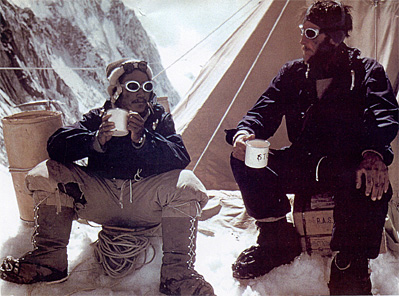
Hillary and Tenzing enjoying a hearty cup of beef tea while scaling their own summit. Image courtesy of bernard-Voyer.com
Yesterday I had the great pleasure of chair in a panel session on technology at the Future Marketing Summit in London. With me were Steve Henry (creative legend and ex-employer), Rory Sutherland (Ogilvy supremo), Amelia Torode (VCCP's digital chief) and David Grebert (P&G's future guru on advertising and instore experience). We were a little light on technologists to be honest but I rather enjoyed myself having these brains at my beck and call.
It is always a pain as a facilitator that you can't lob in your own point of view so I make sure I pissed all over the subject to before hand in my introduction. I talked about the need to retain the magic and delight that new technology brings back to marketing, my preference for tech' that amplifies brand ideas and the need for us to be more modest when approaching new technology and media.
You can download the speech (if you are a regular reader don't expect too much you haven't seen here already) while the slides are on a slideshare (which you won't be able to see if you are reading this as a feed).
Download speech here
View lovely slides here:
Brands rush in where angels fear to tread
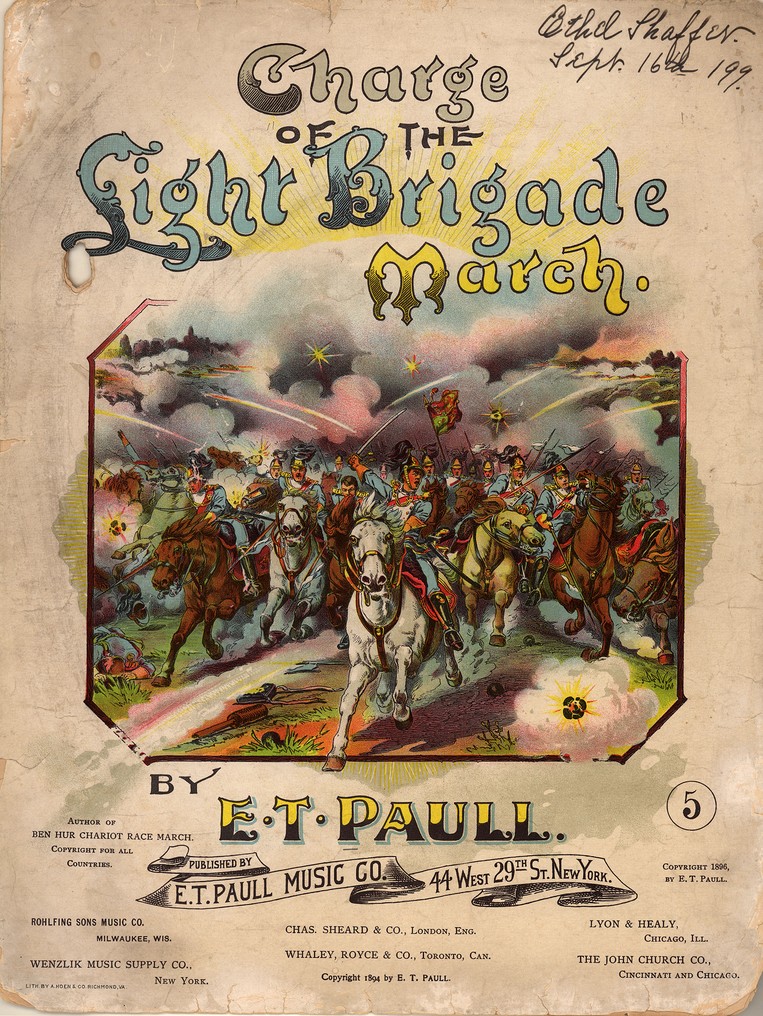 The The Charge of the Light Brigade is in so many ways a lesson for brands that think about social media as just another channel.
As you may know my basic philosophy about brands and web 2.0 is proceed...with caution. Social media is unfamiliar territory for brands and their representatives - largely because the rules are created by the community not the communicators - and they should stear well clear unless they know exactly what they are doing.
Unfortunately unscrupulous advisers and naive brand owners rarely employ this level of discretion and like the proverbial fools that they are rush in to this hostile environment ill prepared and end up as canon fodder for an angry community.
As Alfred Lord Tennyson wrote of the catastrophic charge at the Battle of Balaclava:
Half a league half a league
Half a league onward
All in the valley of Death
Rode the six hundred:
'Forward, the Light Brigade
Charge for the guns' he said
Into the valley of Death
Rode the six hundred.
'Forward, the Light Brigade!'
Was there a man dismay'd?
Not tho' the soldiers knew
Some one had blunder'd:
Theirs not to make reply,
Theirs not to reason why,
Theirs but to do & die,
Into the valley of Death
Rode the six hundred.
I sketched out some rules for brands and social media here. But the man who really knows is of course Hugh over at Gaping Void. I rarely post abut other people's posts but you must read his analysis of why blogging has been so successful for English Cut and his stable of microbrands.
Brands and 2.0 - proceed with caution

I had the pleasure of being at NMK's Content 2.0 conference last week (6th June). We enjoyed some excellent speakers including Marc Canter from People Aggregator, Bradley Horowitz from Yahoo! and James Cherkoff from Collaborate. So I thought I'd put together a set of provocations based on my learning from the day which essentially come under the heading - its all jolly exciting but proceed with caution. This is available to view via slideshare or to download I'm afraid as this is the way the post suggested itself. For a more informed understanding of what went on check out James' blog or go to the NMK link at the top of this post.