
PVRs are so last year
 "With infinite complacency men went to and fro over this globe about their little affairs, serene in their assurance of their empire over matter". H.G. Wells
Only a year ago we were all getting hot under the collar about PVRs and the threat they posed to television advertising.
Now one talks about the PVR peril anymore.
I guess this is partly because PVRs (Personal Video Recorders or Digital Video Recorders) are an accepted and established part of life in the US and UK, and because we are all busy worrying about other stuff.
It is also of course because the plannersphere has given TV advertising up for dead even though many of our clients still depend on it. They need help to build bridges to a new marketing future and by and large the online conversation we indulge ourselves in ignores this.
In this context I want to regurgitate a presentation I wrote a while back on precisely this subject.
I want to do it for three reasons.
1) Although 40% of you are in the UK and another 40% are in the US, many adliterate readers come from territories where PVRs have just or are yet to be introduced. I understand, for instance, that they are about to be launched in Poland and so I thought it would be helpful to revisit some of this PVR stuff for those people for whom this is not old news.
2) It remains the case that we overestimate the short term impact of technology and under estimate its long term impact. We all got terribly excited about the effect e-commerce on retail back in the late '90s, got bored and forgot about it and then woke up to find people had migrated huge amounts of their purchasing online. And so it is with PVRs. We have got bored with them at just the point where they actually might have some effect on the efficacy of brand's activity.
3) While we develop a new marketing orthodoxy we still need to improve the performance of the outgoing approaches. Chatting to Russell recently he likened it to the allies in the Second World War continuing to improve conventional weaponry while simultaneously developing the H-Bomb – a rare militaristic metaphor from the bearded one.
PVRs haven't changed anything
A house ad for HHCL from the early 90's proving that we have always known that ad avoidance is as endemic in the UK as avian flu.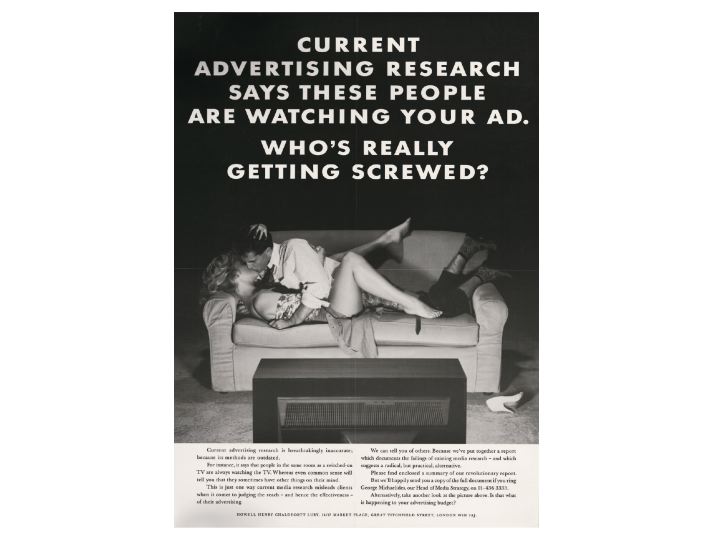
Fast forward ad disgrace
This is a film that forms part of the PVR speech - an ad break of Cannes winners sped up to X30 just in case someone out there still hasn't go the point yet.Bonkers Mazda ad
An old HHCL mazda ad that was a little bonkers in a world of VCRs but may have fortold a way of engaging the PVR generation....Fast forward ads work - it's official
A couple of nice chaps from a research agency called duckfoot popped by to see me recently with some research they had done on advertising and PVRs. Real research mind - that is possibly rather helpful.A couple of nice chaps from a research agency called duckfoot popped by to see me recently with some research they had done on advertising and PVRs.
Real research mind - that is possibly rather helpful.
They have shown that ads watched at up to 30X normal as effective as ads watched at normal speed at driving brand recognition and likeability (when you have already seen that ad). But more than that their research shows that fast forwarded ads can be more effective at this than ads watched at normal speed because we process the information in a less conscious way.
A weird but wonderful study.
Ask them to tell you about it.
PVRs - less talk and more action
It is time we all stopped talking about the future of advertising in a PVR world and started doing something about it. I am working on 20 concrete ideas to get people started. It may end up as a more chuncky ten or as a more Cluetrain like 95. Maybe you can help me on this?Giving your brand a voice in the fast forward future
How long before PVRs start to seriously effect your brand’s ability to communicate with consumers?
I reckon you have got 5 years
By 2010 Sky estimate that time shifting devices like PVRs will be in 34% of UK households
And as we know 92% of all ads watched from the hard disk get zapped.
That’s 5 years to come to terms with the most fundamental change in TV viewing behaviour since the invention of the remote.
Lets get to work.
1. Launch now.
The principle of Brand Darwinism means only the most powerful brands with the greatest creative reputations will survive in the new TV landscape. This will not be the place to launch brands in the future. Pull forward your brand launch plans.
2. Create must watch live programming.
If people watch TV live not off the disk then they can’t skip the ads. It is in every advertiser’s interest to ensure that the schedule contains a healthy proportion of programming that consumers must watch live. Work with broadcasters to ensure this is the case.
3. Change your criteria for pre-testing.
The most important question for any new campaign is not whether it communicates but whether anyone will bother to watch it. And if they do how long they watch it for. The way you evaluate new ideas needs to answer these questions before anything else.
4. Get the sponsorship habit back.
Whatever he value of associating your brand with particular programming there is a big new reason to get keen on sponsorship. Idents are a key navigation tool for PVR owners signaling the end of the break. Surrender your pre break bumpers and double the length of bumpers at the end of the break.
5. Understand the power of the fast-forwarded ad.
At present ad recall is no lower in PVR households than in linear TV households. This suggests that either live programming advertising exposure is sufficient or that fast-forwarded ads have some value. You need to understand what this value is and pay for it appropriately.
6. Be first in break.
Get them before they have time to reach for the remote and zap the break. And ensure that nothing comes between the last frame of the programming and the first frame of your ad. Of course whether people stay with your ad is ultimately down to how good it is.
7. Put your TV expenditure behind the right brands in your portfolio.
PVR research shows that ad avoidance is category specific. Financial service brands have a far tougher time than leisure and entertainment brands. And within this we can predict that ad avoidance is also brand specific with more engaging and familiar brands more likely to have their ads watched. Put your TV cash behind the brands best placed to return that investment?
8. Challenge media planning orthodoxy.
Should coverage and frequency still be your media planning mantra? Arguably TV advertising will reach fewer people less often than at present but with the power to be far more relevant and offering a far richer brand experience. Relevant contact and depth of exposure should replace coverage and frequency.
9. In the short term play with the technology.
PVRs allow consumers to do extraordinary things with the TV – to time shift (even if by a few seconds) to pause, to rewind, to record two programmes simultaneously and to organise their own schedules. The same functionality can now be applied to ads, looks like its time to have some fun.
10. In the long term harness the technology.
Millions of TVs with whapping great hard disks underneath them, containing unparalleled information about the viewer and their behaviour. Far from a threat to marketing PVR technology might resolve many of the downsides of TV as a medium from atrocious targeting to shallow brand experiences.
11. Get serious about interactive TV.
Few advertisers have really explored the full potential of Interactive TV. Interactive TV lets us take the consumer into a brand space that offers unprecedented levels of experience and reward. Interactive TV will no longer be about brand response but about brand involvement.
12. Rethink the structure of your advertising.
In a PVR world not only will the ad sell the brand but to a very real extent the brand will sell the ad. If you brand is potent and has a strong creative reputation brand the beginning not the end of your commercials. If it isn’t you have 5 years to change this.
13. Treat communications like content.
Read my lips – why would anyone want to listen to what you have to say? That is the fundamental lesson to be learned if you brand is going to continue to have a voice. It’s not a hard lesson but a discipline programme makers learned decades ago.
14. Go shorter and longer.
Sure the 30 second ad looks like it’s in for a rough ride but maybe it was always a bit of a compromise – too short for the people interested in what you have to say and too long for those who couldn’t give a damn. The future belongs to the short form directional advertisement (an ad for the ad) and more involving long form communication outside the broadcast stream. Hey isn’t that like online advertising?
15. Don’t be seduced by easy answers.
I love product placement and branded content as much as the next person. But it is folly to suggest that they are the panacea for all the ills the PVR will visit upon our business. There simply isn’t an easy answer so resist the advances of the content charlatans who suggest otherwise.
16. Become media prejudiced.
Different media channels do different things well. Find out which combination of channels can take up the slack if TV becomes less effective for you. Welcome to the new golden age of the poster.
17. Everything is viral.
Even if the television medium works less effectively in the future that does not mean that the brand film will cease to be the single most powerful long-term selling tool. Find as many ways as possible to distribute your brand films to consumers from the cinema to mobile telephony. But remember that the best distribution is consumer driven and that means creating work that people want to pass on.
18. Be excited, be very, very excited.
Fear has no place in the future. The sooner you get excited about the PVR world the sooner you will work out how to make sure your brand will maintains a strong voice in the market.
19. It’s the creative stupid.
Establish a reputation for creative excellence because creativity matters like it never has done before. It’s not about cut through any longer but about the way you chose to engage the consumer in dialogue. It’s a fundamental reason why anyone should give you the time of day when they are armed to the teeth with kit to kill your comms.
20. Stop reading this and start doing it.
Right now you have time to experiment, take some risks and make some mistakes. But be under no illusion time is running out.