
The truth about great planning
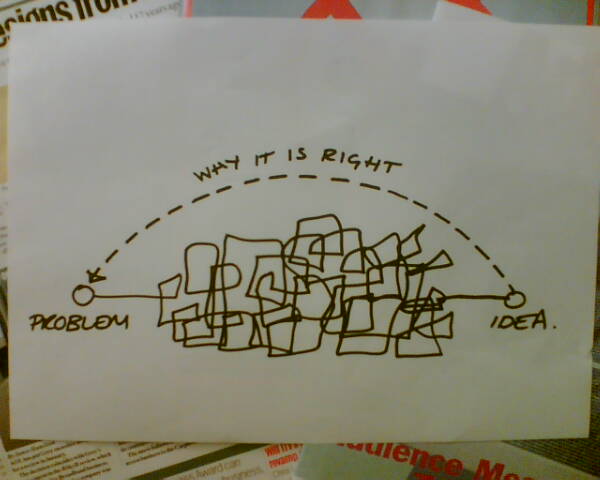
“Theory cannot be fabricated out of the results of observations – it can only be invented” Einstein
Discover more from
Subscribe to get the latest posts sent to your email.
“Theory cannot be fabricated out of the results of observations – it can only be invented” Einstein
Subscribe to get the latest posts sent to your email.
Comments are closed.
communications theory is buggered then.
Interesting.
Although theory cannot be fabricated from observation, surely it can be inspired/pushed/suggested through it.
Its not like he just sat there one day and came up with the theory of relativity. He MUST have worked on it and made observations to be able to come up with it…
That chart is brilliant. Planning is 90% scrambling around in the dark looking for light and 10% post-rationalisation after someone finally has a brilliant idea.
I think E meant: theory can only be invented out of the results of observations, not fabricated.
I don’t think that is what he meant at all.
I first came across this quote in a speech stephen king gave in 1974. He used it to support his contention that ‘facts only make sense in the light of an idea’.
The best strategy comes from having an idea and then seeing whether the facts can stand it up. Indeed more than that I believe its as simple as thinking of the most interesting thing you could say about a brand and then proving whether you instincts are right. Facts can help as food for thought but they won’t take you there themselves.
I prefer to look more dialectic at strategy vs. idea or facts vs. thoughts. I think clever facts/strategies come from clever ideas/thoughts which come from clever facts/strategies which come from clever ideas/thoughts and so on.
I think facts are foods for thoughts as well as thoughts are food for facts. Useful facts are human interpretations, aren’t they? They make sense in the light of an idea. And interpretations always appear in some kind of framework. If you are a practitioner you might call that framework for intuition or thoughts, if you are an academic you might call it theoretical framework.
What’s the point to decide on whether it starts with facts or ideas? Is it to say ideas are better than facts or that creative work is more important than research? I think they should be equal and inseparable.
I love this quote and the pic.
What I get from it –
You can pile up your stats and facts as high as you want to have them, in order to safe gaurd yourself. But they won’t lead you to invention.
True invention and great ideas come from taking creative leaps.
Of course you can back your idea up before or after that creative leap. But a creative leap MUST be involved… otherwise you’re just spinning the same shit. ie. not invention.
Cheers Einstein & Richard
I think new ideas are the results of new combinations of old stuff. That old stuff can be bits and pieces from research, your life or whatever. Great ideas, creative laps wont happen in a vacuum (there is always some kind of input, springboards). Divine creativity don’t exist.
Well performed research, among other stuff, act as springboards for creative laps.
I don’t understand this picture. It’s basically IMPOSSIBLE to see where the middle line is going.
However, I agree with Einstein as this sort of thing happens to me all the time and I OFTEN say much the same quote when it does.
My latest non-fabricated but invented theory is that something like the internet but better will soon happen.
If you think about it (like I have), no one had heard of the internet ten years ago but now you can buy it in Woolworths and even online. So almost definitely something better will come along (in the same way that everyone was listening to Neil Diamond until Graceland came along). Take note and buy shares now!
You’ll probably be able to buy it online at first, but then you’ll just be able to get it through whatever it is.
Thankyou Mrs Belmont, you always add clarity in such a confusing and complicated world.
I meant “leaps” not “laps”.
Whatever that “new internet” is, we will have seen it before. Think about it:
Graceland was South African folk blues updated. Neil Diamond came back last year with 12 Songs produced by Rick Rubin of Johnny Cash revival fame. And I still have this niggling idea that blogs are just CB radio with greater reach. And that makes the Russell Davies coffee mornings just eyeballing sessions. And I think Adliterate is The Book of Gossage updated. (which is a very fine compliment indeed – Gossage introduced Marshall McLuhan to the world and at the same time refused to do that new fangled TV ad thing)
As a species we are very very good at finding new ways to meet the same old needs.
Which is why Digital is just a new advertising medium.
ahh. Sweet post-rationalisation.
Very true about graceland. Though I will argue strongly that Rick Rubin is a genius in his own right, not just he of Johnny Cash revival fame…!
Breaker Breaker. This is FR calling. Discussion of Bravia ad open.
Maybe digital is the new teletext?
I’m no physicist but being a planner that makes me one of the many ‘mongrel scientists’…
Einstein was simply arguing for deductive reasoning in science, i.e. theory-hypothesis-observation-confirmation. As opposed to inductive reasoning, i.e. observation-pattern-hypothesis-theory. Essentially, top down vs. bottom up.
The reality for planning is that the two approaches are interlinked in a circular manner, a good planner just knows where start.
Hello Phil Teer,
The CB/Ham Radio analogy is a very good one and EXACTLY spot on. In fact, it is an analogy that I discovered and made my own back in August.
http://forum.brandrepublic.com/messageview.cfm?catid=2&threadid=3660
Everyone have a GREAT weekend!
Thanks, Yusuf Chuku.
And so you did Mrs Belmot. Makes me think that while planners are often accused of doing nothing but post-rationalisation (as if there is anything wrong or easy about that) creatives get tagged with stealing others ideas which is often nothing other than serendipity or, at worse, a healthy Magpie instinct.
Anyway, I never read brand republic…
Post rationalisation is not a bad thing. Its what happens in real life. At the end of the day our brains can work through all the information and spit out something at such a speed that we dont need to go step by step through a process to get there. Just because most agencies show the process they go through doesnt mean individuals need to be that slow.
I think the strength of Malcolm Gladwells book Blink is a prime example. We just need to go back through all the reasons to justify for others to understand … why its worthwhile